While strongly supporting the strategic concept, we must draw attention to several practical issues and put forward positive suggestions to refine and improve the current proposals.
1. Integration with possible longer-term gyratory improvements
The combination of the proposed Superloop service and its associated increase in passenger volumes necessitates a holistic approach to managing the Tulse Hill gyratory. We urge TfL to ensure that the proposed Superloop SL15 route provision is fully considered within the ongoing development of the Tulse Hill Long Term Change Project. This second stage design work, including the testing of options such as footway buildouts and bus priority sections, offers a unique opportunity to deliver better bus facilities and encourage increased use of the new service. Such an approach could also provide electric bus charging facilities (see point 4.)
The full benefits of the new route will not be realised if buses get caught in congestion on the Tulse Hill gyratory or pedestrians do not feel safe accessing the stops. By fully considering these points in the round as part of a long-term plan for Tulse Hill, the wide-ranging benefits of the new service can be fully realised with the area becoming a ‘Superloop Hub’. This could potentially also offer stops for the SL6 service which currently drives straight through without stopping (see point 7.)
2. The benefits of an integrated and collaborative approach involving the local community
Faster, safer and more accessible walking connections to all the bus stops at Tulse Hill Gyratory from Tulse Hill Railway Station, including those proposed for the new SL6 route, would make this service far more attractive to people travelling from and to this busy area of South London.
An integrated approach, correctly executed, could significantly contribute to increasing public transport usage, reducing reliance on private cars, and achieving our shared aim of transforming Tulse Hill for the better. We seek a commitment to active, ongoing engagement with Transform Tulse Hill, the Station to Station BID, the Norwood Forum, and local elected representatives on this matter.
3. Inadequate passenger facilities and the local impact
We express our concern regarding the currently inadequate passenger facilities at the proposed bus stops. The shelters are limited in size, and the poor placement and scarcity of on-street litter bins result in significant littering around the shelters and into adjacent private gardens. This increases cleanup costs for Lambeth Council and negatively impacts the local area, including reducing its attractiveness as a place to visit, shop and do business. A better approach must be considered with Lambeth Council and their contractors Veolia – this has the support of our local Ward Councillors who have raised this issue previously on a number of occasions.
We also have observed instances of bus drivers not using the appointed TfL toilet facility on Christchurch Road, instead using local gardens and alleyways. We urge that all bus operators are formally reminded to mandate drivers to use this designated facility only.
4. Green infrastructure and air quality
To mitigate air quality concerns and align with TfL’s environmental targets, we request clarification that the new single deck buses for the Superloop service will be fully electric. TfL has committed to ensuring all new vehicles entering service are zero-emission but no information has been provided with the consultation information as to which vehicles will be used, and we request more details are made public.
We wish to raise the all-too-common practice of drivers leaving diesel bus engines idling whilst waiting at Bus Stop E. Given the high levels of air pollution and particulates in this specific location, we require a firm commitment to prevent this unnecessary contribution to poor local air quality.
TfL has evaluated through a trial in Lewisham of green roofed bus stops and has decided not to roll these out across London. This is disappointing and we would encourage TfL to see Tulse Hill as an ideal location for testing out new and innovative approaches for bus shelters, including greenery / planting. There is an active community of volunteer gardeners supported by not-for profit organisaitons in the area who may be willing to support and maintain any new provision.
Examples already exist of how green infrastructure can enhance a local area, including on Red Routes. TfL and local councils have implemented various green infrastructure projects near busy roads. For instance, Lambeth Council, often with TfL collaboration, has installed dense ivy green screens at the perimeters of numerous schools bordering busy roads like Brixton Hill.
These screens, acting as linear pollution and noise barriers, significantly reduce particulate matter (PM) exposure for pedestrians and students. Larger, more formal green walls have been installed at transport assets like Edgware Road Tube station and near Blackfriars Bridge, serving examples of TfL’s efforts to enhance air quality, reduce noise, and boost biodiversity in highly urban areas adjacent to heavy traffic.
We would like to see such options considered for the bus stops that the proposed SL15 service would use and adjacent areas to them, although we understand this would need to be considered as part of a longer-term approach rather than being introduced when the new service commences.
5. Safety and security
There is a high prevalence of crime in Tulse Hill. To help counter this, and support the police, bus shelters could be equipped with CCTV. We note that TfL is doing this elsewhere in London and that measurable benefits have been seen. The trial results have found that 80% of surveyed women feel safer with CCTV at bus stops they use, and in addition 73% would be more likely to use buses if use of cameras was extended. Introduction of this technology at bus stops in Tulse Hill would help deter crime, which is an issue locally, with the system providing 31 days of recording for police investigations. These cameras have been shown to have a “very positive impact” according to TfL’s Chief Operating Officer.
6. Inaccuracy in consultation materials
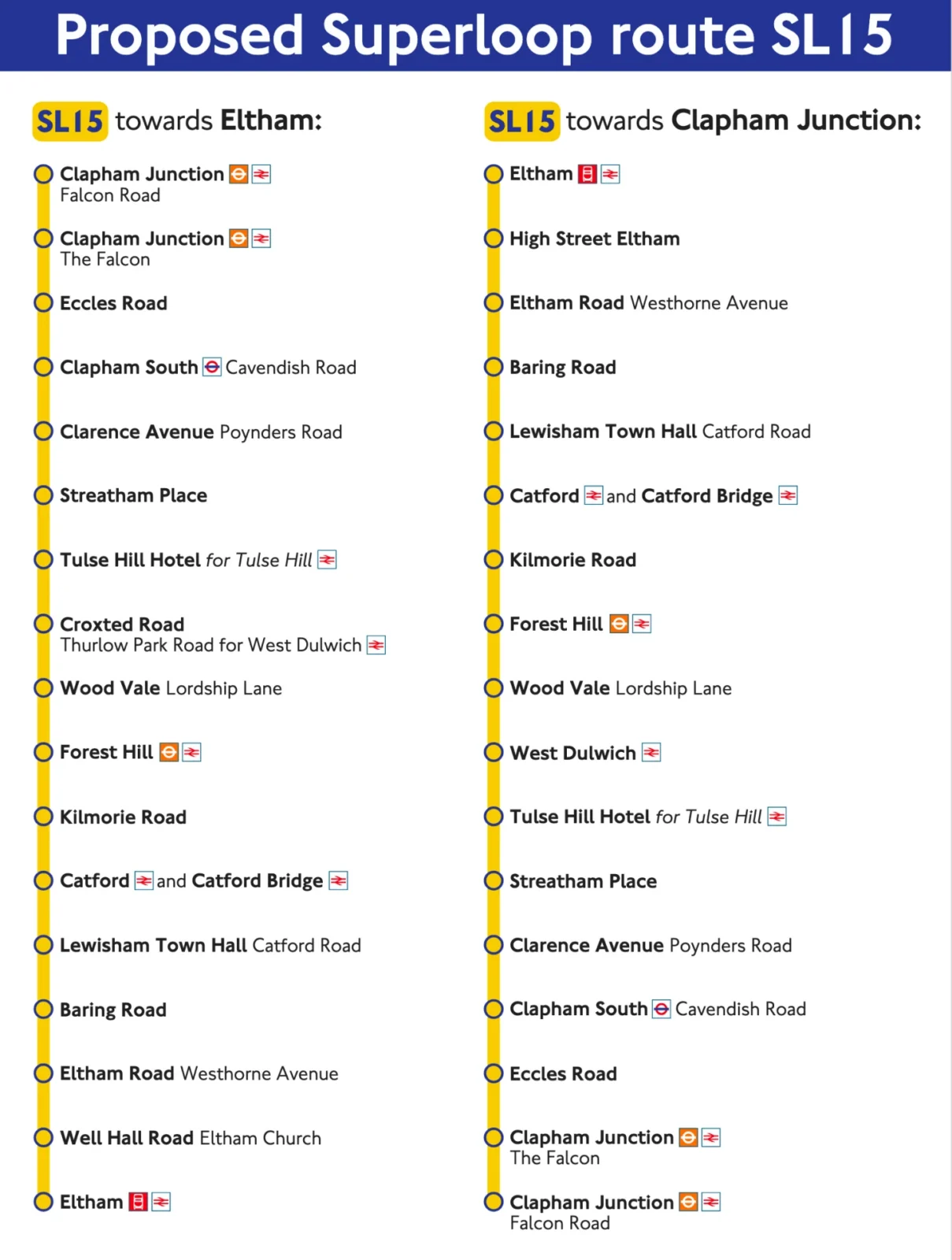
We wish to flag an apparent error in the diagram named ‘Proposed Superloop route SL15’, accessed via the ‘Maps and more information button’ on the TfL Have Your Say consultation page.
On the route map, it incorrectly states that both directions of the service will use the bus stop at the Tulse Hill Hotel (Stop A) on this list of stops. The ‘SL15 Geographic map’ is correct).
Due to the one-way gyratory system, the service heading towards Clapham Junction must actually use Tulse Hill Station (Stop E).
This inaccuracy could cause customer confusion and should be clarified when the consultation results are made public. We support the proposed service stopping at Stop A and Stop E.